The Title 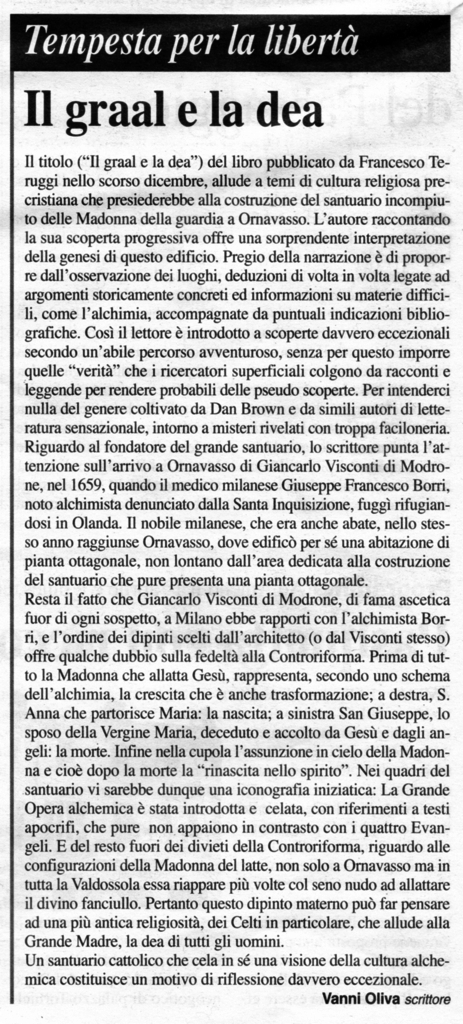 , Holy Grail and The Goddess, the book published by Francis Teruggi last December, alludes to themes of pre-Christian religious culture that would preside over the unfinished building of the shrine of Our Lady of the Guard at Ornavasso. The author telling his progressive discovery provides an amazing interpretation of the genesis of this building. Merit of the narrative is to propose the observation of places, deductions from time to time related to topics and historically concrete information about difficult subjects, such as alchemy, accompanied by precise bibliographic references.
Thus the reader is introduced to discoveries really exceptional according to a clever adventure trail, without imposing the "truth" that researchers superficial grasp of stories and legends of the pseudo likely to make discoveries. To speak nothing of the kind cultivated by Dan Brown and similar authors of sensational literature, mysteries revealed around with too much carelessness. With regard to the founder of the great sanctuary, the writer focuses attention upon arrival in Ornavasso Giancarlo Visconti di Modrone in 1659, when the Milanese physician Francesco Giuseppe Borri, known alchemist denounced by the Inquisition, he fled taking refuge in Holland.
The Milanese nobleman, who was also abbot, in the same year reached Ornavasso, where he built for himself a house is octagonal in shape, not far from the area dedicated to the construction of the sanctuary which also shows an octagonal. The fact remains that Giancarlo Visconti di Modrone, renowned ascetic beyond all suspicion, Milan had dealings with the Alchemist Borri, and the order of the paintings chosen by the architect (or the same Visconti) offers some doubts about the loyalty to the Counter .
First of all the Madonna nursing Jesus, is, according to a scheme of alchemy, the growth that is also transformation, on the right, S. Anna Maria giving birth: birth, left St. Joseph, the husband of the Virgin Mary, died and welcomed by Jesus and the angels of death. Finally in the dome in the intake cycle of the Madonna that is, after the death of the "rebirth of the spirit." In the paintings of the sanctuary there would thus be initiatory iconography: The Great Work of alchemy was introduced and concealed, with references to apocryphal texts, which also do not appear to contrast with the four Gospels.
And out of the rest of the prohibitions of the Counter regard to the configurations of Our Lady of milk, not only in Ornavasso but throughout the Valdossola it reappears several times with bare breasts to nurse the divine Child. Therefore this painting breast may suggest a more ancient religion, Celts in particular, which alludes to the Great Mother, the goddess of all men. A Catholic shrine that conceals an alchemical vision of culture is a matter of reflection truly exceptional.
Vanni Oliva
Ecorisveglio, 27 Marzo 2013, Edizione del Verbano, p.46