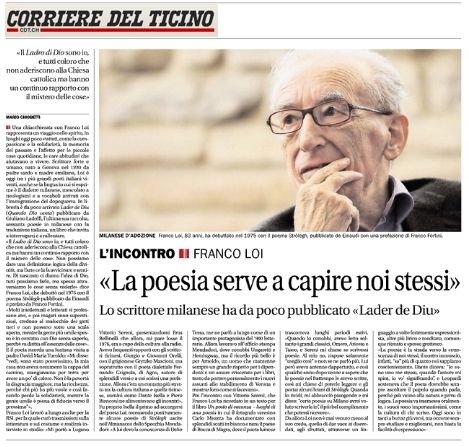
 A chat with Franco Loi is pushed into a journey into little-visited places today, such as compassion and solidarity, the memory of the past and affection for the little everyday things, the care habits that helped to live. Strong writer and human being, born in Genoa in 1930 by a Sardinian father and mother Emilia, Loi is now one of the greatest Italian poets living, even if the language in which it expresses is the Milanese dialect, mixed with neologisms and words arrived with the 'Post-war immigration. In the library has just arrived Lader De Dieu (When God Sings) published by Giuliano Ladolfi, his last collection, sixty poems in Milan with Italian translation. a book that invites you to question themselves and slow down. "The Thief of God I am, and all those who do not adhere to the Catholic Church but they have an ongoing relationship with the mystery of things. We can not give a logical definition of the deity, but the art make it closer and feel.
Secretly give us the idea of God , we can all do it, but often go through things without seeing them , "says Franco Loi , who made his debut in 1975 with the poem Stròlegh published by Einaudi and preface by Franco Fortini .
"Many intellectuals and writers profess to be atheists , and then maybe I'm superstitious , they believe in the evil eye of cats and blacks do not pass under an open staircase , while the humble people is often in contact with God without knowing it, because it goes straight to the essence of things. " - And the poet recalls a distant visit to Father David Maria Turoldo , "I said, " See , I was poor , my house did not even have the chimney , ate on the ground to have a little ' heat . It is the misfortune greater poverty , but wealth , because who wants to have more and more in doing so loses solidarity. while the humble people is full of confidence to the next . '"
Franco Loi worked for a long time for CSR , for which oversaw broadcasts on literature and on the costume and carried out interviews in the studio : " He took me to Lugano Vittorio Sereni , introducing Eros Bellinelli that back then, I think it was 1976 , was head of the culture on the radio. I had frequent contact with the writers Ticino , Giorgio and Giovanni Orelli , with the Grison Grytzko Moscioni , but especially with the dialect poet Fernando Grignola , Agno , author of splendid verses and I wrote a preface .
Then there was a closer contact between the Italian culture and the Ticino , men like Dante Isella and Reno Bianconi they fed the meetings . " Isella It was the first to notice the poet Loi , positively reviewing some poems by Mondadori Stròlegh outputs nell'Almanacco the Mirror : " I owe to him the knowledge of Delio Tessa , talked to me for a long time as an important protagonist of the 900 literature. I was working Mondadori Printing Office , where I met Ungaretti and Hemingway , but the best memory is for Arnold , a man who always maintained a great respect for employees and a passionate love for books , so as to bring myself to new hires Verona plant and show them how they were doing . "
Then he met Vittorio Sereni, that Franco Loi recalled in a text book for a place to vacation - places of a poem in which the photographer Varese Carlo Meazza has documented with beautiful black and white shots the village of Bocca di Magra , where the poet spent long periods luinese summer .
" When I met him , I had read only the classics , Homer, Ariosto and Tasso, and Sereni asked me if I wrote poems. To my no, answered only " better this way " and did not speak again . But he had antennas everywhere, and so a few years later he was informed that the poems in the meantime I had written , so he asked me to read them and some pieces of chicken coops Stròìegh . When I saw him , he hugged me crying and told me, " certain poems of Milan I wanted to write to me " the best compliment I could receive . "
Since then Loi has never failed in its creed, to give voice to the dispossessed , the exploited , through a language sometimes strongly expressionist , others are more lyrical and thoughtful , however, rhythmic and often grotesque. "Poetry is the road to the knowledge of ourselves, our unconscious , in fact, " know " more than we consciously know . Dante said : " I am one myself , when love inspires me , I go ' meaning" , and Leopardi argued that the poet should always listen to the people when he speaks, because you closer to nature and devoid of logic. 's Poem goes transmitted orally , the sounds are very important , as the culture of the writer. Nowadays there are many ways to jot down , but it is always necessary to study and improve, not just the ease of expression . "
Mario Chiodetti
Corriere del Ticino