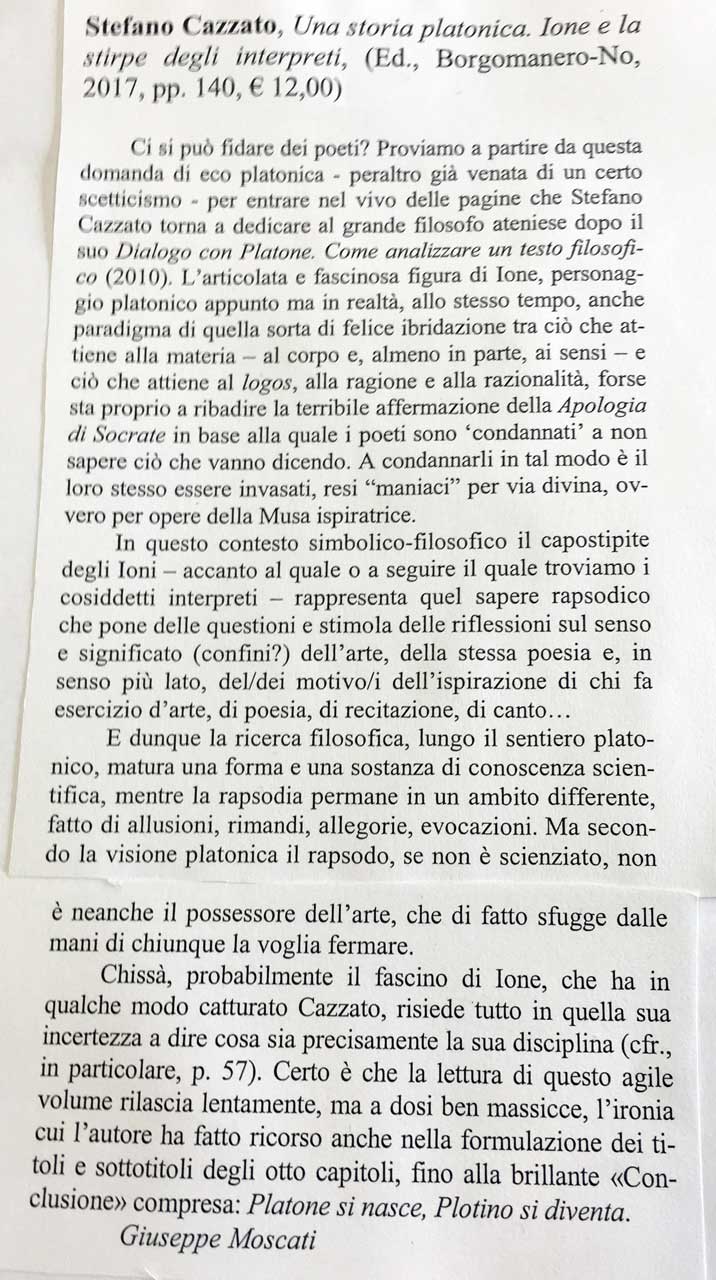
First reading: Where he imagines (reflections on Rapsodi, Aedi, Iperuranio and Blue Notes)

I am certainly not a historian of philosophy nor an expert on Plato and I love philosophy as anyone who has chosen the artistic mirror of his life, a mirror that knows how to give balance and knows no falls and, if anything, pushes the observation of the Self in the History of Ideas , in the History of the whole Humanity.

This is why I feel free to travel in the Free Text of Stefano Cazzato without any limit even to a first reading, "Open Work" that can not lead me to the expansion of my freedom of interpretation, one of many possible and, I believe and I hope, acceptable .

"A Platonic story": Stefano Cazzato certainly does not lack the ability of the linguistic game, the love for the aphorism, the disenchanted vision of the epistemological charade and, above all, the love for that expert Game that travels in the memory of who knows how to make culture with the noble sense of lightness.

A Platonic story or a History of Love (Eros and not Thanatos) sublimated to reach Upper Love (Art, Moral, Science, Spirit)? I do not believe. A Platonic story that lives on reflections rather than material practices; a written and unwritten history, a story made up of stories that refer to other stories, all being stories of history.



written by Gabriella Mongardi

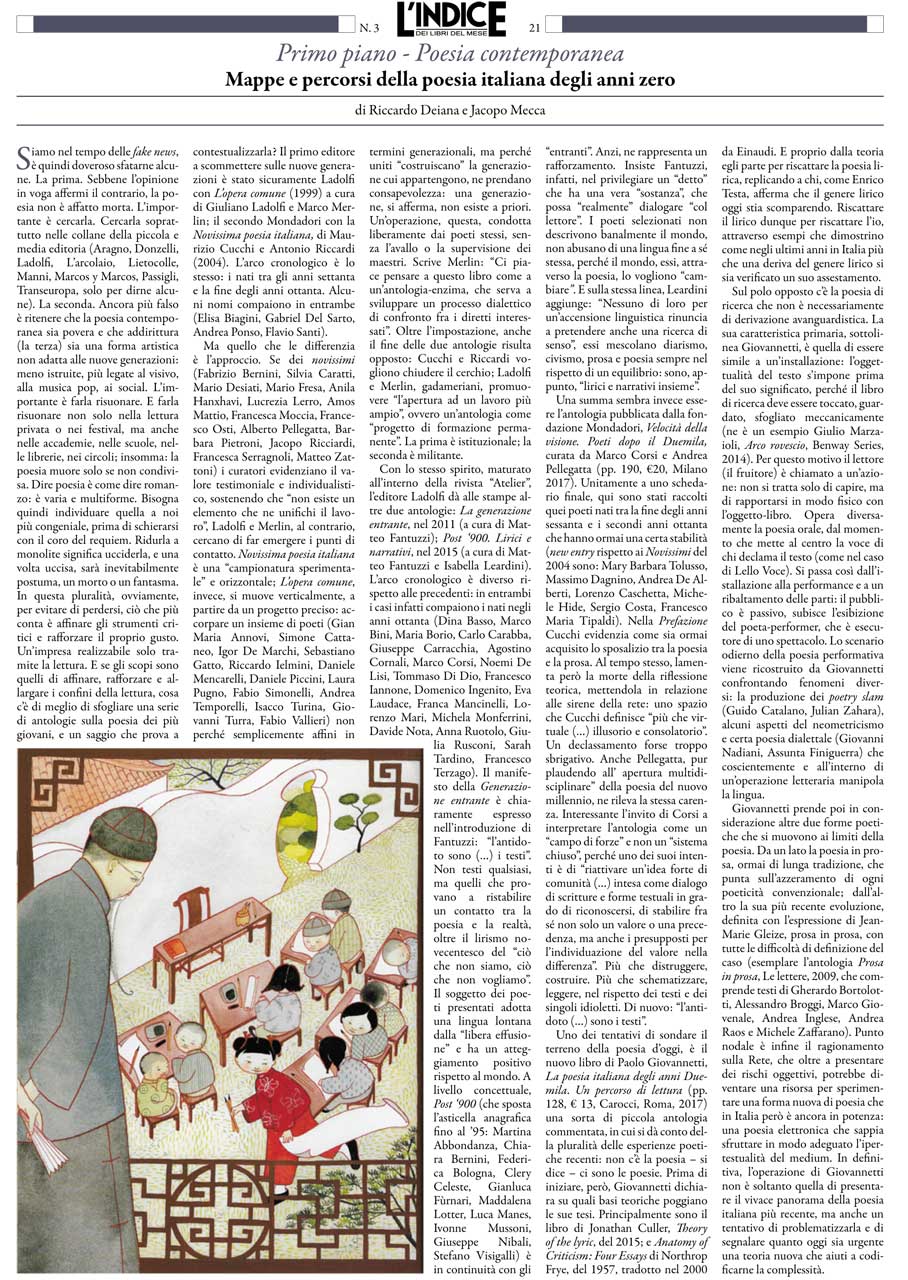
That of Fabiano Spessi is a poem that gets dirty hands. With full warning and deliberate consent. This character, already evident in the previous collection, A promise of happiness, Ladolfi publisher 2016, is even more pronounced in The Second Birth, always released by Ladolfi in December 2017.

The long liminal poetry of The second birth, A liar way of telling the truth, is a real manifesto of poetics, starting from the oxymoric title which is a splendid definition of the Literature, a definition in which the echo of the dickinsonian imperative "Tell the whole truth, but give it oblique". In the case of Emily Dickinson, the "obliquity" is given by the daring metaphors, the broken syntax that make her hermetic, obscure diction; in Spessi, on the other hand, he seems to feel almost an intolerance precisely because of poetry understood as "writing in verse", as a high register of the language; and in fact his verses tend to prose both for lexical choices, both for the absence of rhymes, and above all for a "going to the end" that seems casual, careless, sometimes even wrong.


written by Franca Alaimo

Until a few decades ago few Italian poets had the courage to clear the sex from reticence and deliver it to a bold, if not obscene, vocabulary.
I am reminded of only Maria Grazia Lenisa, now disappeared, and Patrizia Valduga, although so distant and for intent and for stylistic yield: the first, in fact, sings God through the human language of eros, and the body through the stylistic features of sacred, with the intention of overcoming every fracture between flesh and spirit, both wishing; the second, instead, mixing together the composure of the formal structure, so widely drawn from tradition, with a "dirty" lexicon often from the crudest obscenity and a clear rejection of all metaphysical shelter, underlines the fracture between the masculine psyche and the feminine one that also marks the gestural and libidinous one, leaving, all in all, on the scene of literature its nakedness without shelter.
Lenisa has found few followers in Italian literature, in general (and not only, as I suppose, for the difficulty of the challenge). Among the authors of this anthology, we can approach only the Narimi, the Monachino (with their happy grafting and shedding of mystical fervor within the vital-erotic rhythm of the Universe) and the Cerniglia that draws widely from the myth to halo of ideal beauty. intimate and real.
Many Italian authors, however, have set foot in the footsteps of Valduga, claiming full freedom of expression in the field of erotic matter, which Rimbaud already wished as an index of a future, achieved equality between men and women (not for nothing Lenisa he called himself "the girl of Rimbaud"), aware of the assumption that the written language has always coincided with the interests of the ruling class


  1. Andromeda su L'EstroVerso
  2. Andromeda on Literary
  3. Tutto o niente ON Odissea
  4. Eratoterapia on Silarus

Page 16 of 76

ACQUISTI

Per acquistare i nostri libri

inviaci una richiesta a

ladolfi.editore@gmail.com


If you want to purchase

our books

please send a request to

ladolfi.editore@gmail.com


GIULIANO LADOLFI EDITORE s.r.l.

Corso Roma 168

28021 Borgomanero (NO)

Tel. +39 0322 835681

This email address is being protected from spambots. You need JavaScript enabled to view it.

NEWSLETTER SUBSCRIPTION

I agree with the Terms and Conditions

Per offrire il miglior servizio possibile questo sito utilizza i cookies. Continuando la navigazione si autorizza l’uso. To offer the best possible service this site uses cookies. By continuing to browse, you authorize use.